
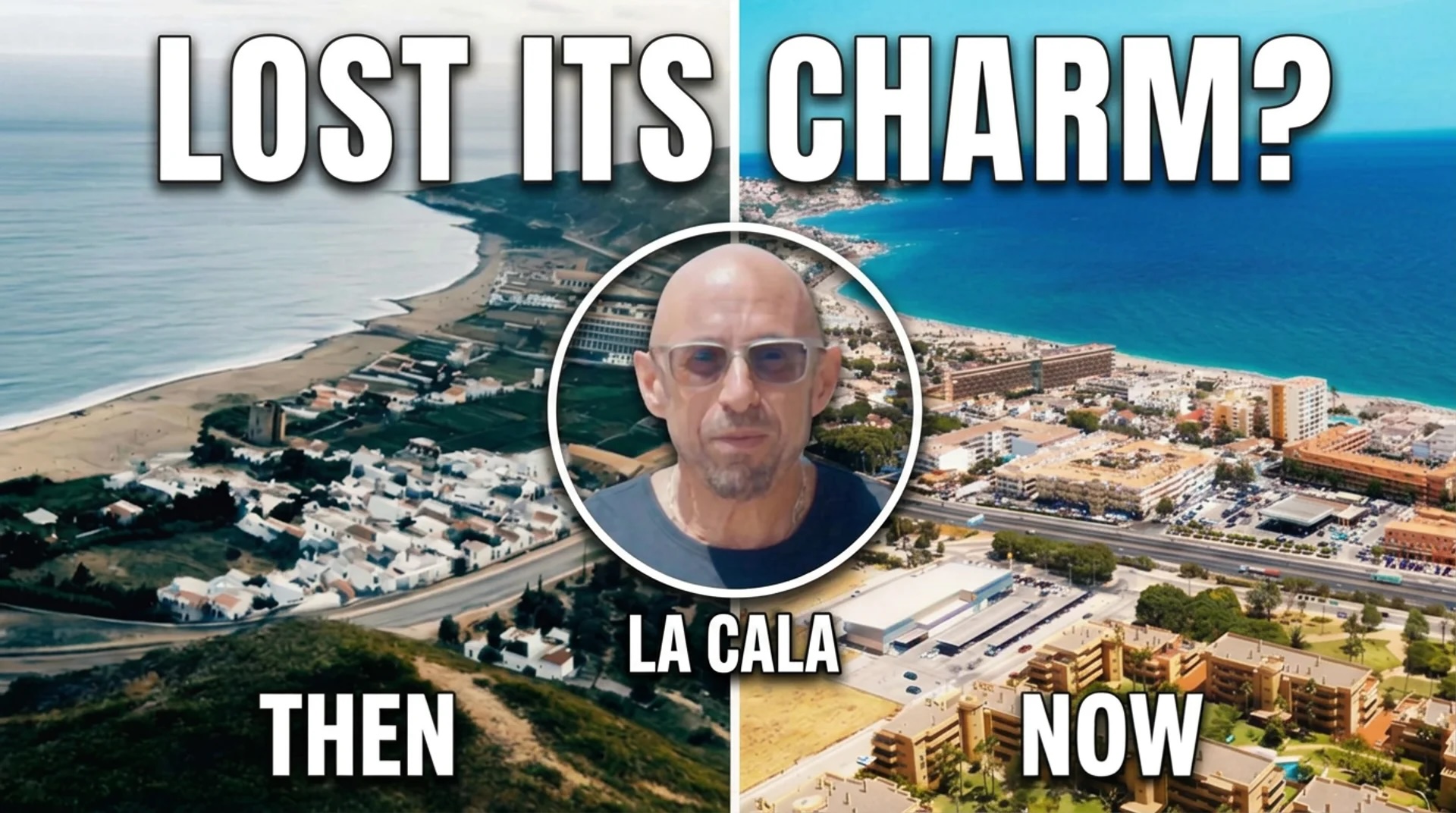
Every summer, the same debate resurfaces online: has La Cala de Mijas lost its charm? Some say it’s become too busy, too commercial, and too expensive. Others say it’s simply grown into one of the most desirable places to live on the Costa del Sol. Both sides usually argue from opinion, so we went out and asked the people who’d actually know.
In this video, Keith from Target Property Spain, who’s lived and worked on the Costa del Sol for over 20 years, spoke directly to residents, business owners, tourists, and long-term locals to find out whether living in La Cala de Mijas today is genuinely better, worse, or just different from what it used to be.
Why People Say La Cala de Mijas Has Changed
Ask anyone who’s lived in La Cala de Mijas for a decade or more, and you’ll usually hear the same complaints:
- Traffic — access from the A-7 has become a genuine pressure point, with queues backing up toward the motorway at peak times, and local traffic forced through the village centre just to rejoin it.
- Rising property prices — La Cala de Mijas property prices have climbed sharply over the last ten years, making it harder for new buyers to get a foothold in a market long-term residents remember as far more affordable. Idealista’s price trend data tracks this rise across the wider Mijas Costa area.
- Overdevelopment — more apartment blocks, more construction, and a townscape that looks very different from the quiet fishing-village character many older residents remember.
- Overtourism — a stronger seasonal influx of visitors, busier restaurants, and a paseo that can feel more like a resort strip than a village high street in peak season.
These aren’t complaints from outsiders, they’re the honest views of people who’ve watched La Cala de Mijas grow from up close.
What La Cala de Mijas Was Really Like Before the Boom
To understand what’s actually changed, it helps to know what was there to begin with. A few decades ago, La Cala de Mijas was a small, relatively undiscovered fishing village, simple, quiet, and largely unknown outside the immediate area. Mijas Ayuntamiento’s population records show how sharply that’s shifted over the past two decades, in line with growth seen across much of the Costa del Sol.
That context matters, because it reframes the question. The debate was never really about whether La Cala de Mijas was going to change — coastal towns with this much natural appeal always do. The real question is whether that growth has been managed well.
The Other Side: What’s Actually Improved
It’s easy to focus on what’s been lost. But talk to recent arrivals, business owners, and younger families, and a different picture emerges. More restaurants mean more genuine choice, not just more crowding. A better, safer, more walkable boardwalk benefits everyone who lives there year-round, not just visitors. Newer development, done well, often means better-built homes than much of what previously stood in their place, similar to the pattern we’ve seen play out in neighbouring Riviera del Sol and Calahonda over the same period.
Both of these stories are true about La Cala de Mijas at the same time, which is exactly why a simple “ruined” or “better than ever” verdict misses the point.
Why Keith Moved From La Cala de Mijas to Riviera del Sol
One of the most honest moments in the video is Keith’s own admission: despite years of living in La Cala de Mijas, he chose to move a short distance down the coast to Riviera del Sol. Not because he stopped loving the town, but because of a specific trade-off — he wanted the lifestyle La Cala offers (the beach, the restaurants, the boardwalk) without the daily cost of living inside its busiest, most congested streets.
As the owner of a local real estate agency, Keith is upfront about his bias — he has a professional interest in people wanting to live on this coast. Rather than avoid that conflict, the video addresses it directly, which is part of what makes the verdict worth taking seriously.
So, Has La Cala de Mijas Lost Its Charm?
The honest answer: not exactly. La Cala de Mijas hasn’t lost its charm so much as changed what its charm is built on. The sleepy fishing village of two decades ago is gone, and it isn’t coming back. What’s replaced it is a busier, more expensive, but genuinely more complete town, one that works well for families, retirees, and long-term residents, even if it now demands trade-offs that didn’t exist before.
Whether that’s a net gain or a net loss depends entirely on what you’re looking for.
Frequently Asked Questions About La Cala de Mijas
Is La Cala de Mijas still worth living in? Yes, for many people, but it depends on priorities. If you want a walkable, lively coastal lifestyle with restaurants, beach access, and a strong community, La Cala de Mijas still delivers. If you want the quiet, low-key village atmosphere of 20 years ago, that version has largely disappeared.
Has La Cala de Mijas got more expensive? Yes. Property prices in La Cala de Mijas have risen significantly over the past decade, in line with broader demand across the Costa del Sol. Affordability is one of the most common concerns raised by long-term residents.
Is traffic bad in La Cala de Mijas? At peak times, particularly summer and school run hours, access via the A-7 slip roads can back up significantly, and local traffic is often funnelled through the village centre. It’s one of the most consistently raised frustrations among residents.
Is La Cala de Mijas a good place to buy property in 2026? It depends on your goals and budget. La Cala de Mijas remains a strong long-term option for those prioritising lifestyle and walkability, though buyers should factor in current price levels and peak-season congestion. Speaking with a local agent familiar with the area is the best way to weigh the trade-offs for your specific situation.
What is La Cala de Mijas like to live in? La Cala de Mijas is a walkable coastal town with a beach, boardwalk, restaurants and shops all reachable on foot. It has grown substantially over the past two decades, offering a busier, more amenity-rich lifestyle than its original fishing-village character, with trade-offs in traffic, price, and seasonal crowding.
Is La Cala de Mijas touristy? Yes, particularly in summer, when the population swells significantly with visitors. Outside peak season, it retains more of a local, residential character, though the town has become steadily more commercial and tourism-oriented over the past decade.
How far is La Cala de Mijas from Marbella and Malaga Airport? La Cala de Mijas sits roughly midway along the Costa del Sol, within easy reach of both Marbella and Fuengirola, and around 25-30 minutes’ drive from Malaga Airport via the A-7 and AP-7 motorways, traffic permitting.
Thinking About Moving to La Cala de Mijas or the Costa del Sol?
If this video and article have you considering a move to La Cala de Mijas, Riviera del Sol, or elsewhere along the Costa del Sol, Target Property Spain offers a free Costa del Sol Buyer’s Guide and a Property Alert List for new listings before they hit the open market. No sales calls, no pressure.
👉 Download the free Buyer’s Guide
👉 Property Alert List — be first to hear about the right homes
About the Author
Keith has lived and worked on the Costa del Sol for over 20 years and owns a local real estate agency covering La Cala de Mijas, Riviera del Sol, and the wider Mijas Costa area. Target Property Spain is a registered member of GIPE (Grupo Inmobiliario Profesional Español) and rated 5 stars on Google.
Target Property Spain S.L. · CIF B93358505 Registered office: Calle Merida de Jarales, Local 9, Calahonda, Mijas Costa, 29649, Málaga, Spain
Areas covered: La Cala de Mijas · Mijas Costa · Riviera del Sol · Calahonda · El Chaparral · Fuengirola · Marbella · Costa del Sol · Malaga Province