
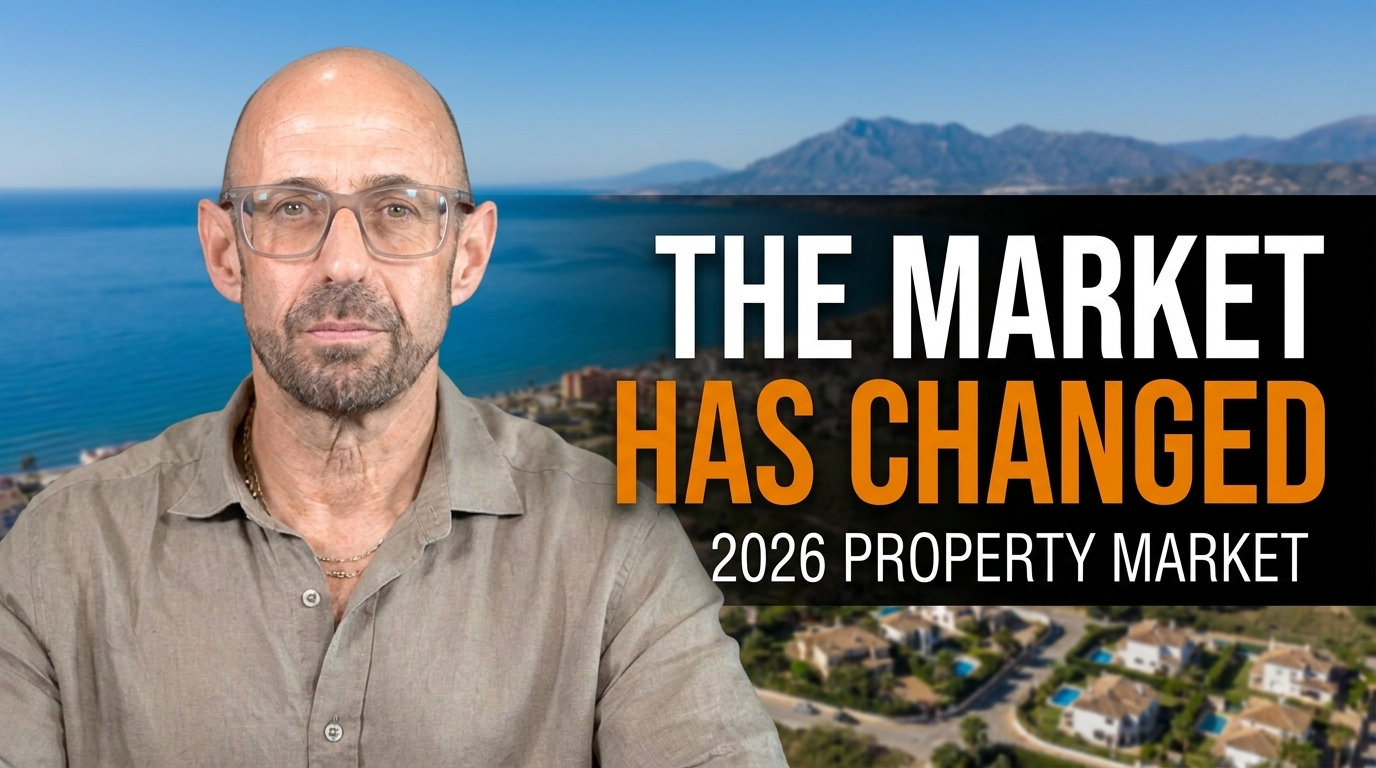
Málaga province property prices are up around 14% year-on-year, according to official data from the Spanish Ministry of Housing and Urban Agenda. On paper, that looks like a market accelerating. It isn’t, and understanding the difference matters if you’re buying or selling property anywhere from Mijas Costa to Marbella this year.
In this video, I break down what’s actually happening across the Costa del Sol property market right now. Here’s the written version, with the detail behind each point.
The headline number: Málaga property prices up 14%
The Ministry of Housing and Urban Agenda’s official appraisal (tasación) data puts Málaga province at an average of 2,988 €/m² in early 2026, a 14.2% increase year-on-year, making it the fifth most expensive province in Spain by price per square metre, behind only Madrid, the Balearic Islands, Guipúzcoa and Barcelona. Mijas Costa has been firmly part of that momentum.
What the headline doesn’t tell you: sales volume is falling
Here’s what most coverage of the Costa del Sol property market misses. According to INE (Spain’s National Statistics Institute), property transactions in Málaga province fell 9.3% in the first quarter of 2026 compared to the same period in 2025, and one month alone, March, was down more than 13% year-on-year.
Put simply: prices are still climbing, but fewer sales are actually going through. That combination, rising prices, falling volume, is the classic signature of a market normalising after a period of frenzy, not a market overheating further.
Compare that to 2024 and 2025, when it wasn’t unusual to see multiple offers on the same property, buyers waiving conditions, and deals closing within days because hesitation meant losing out. That pressure has genuinely eased. Buyers today have time to view a property twice and get a proper survey done before committing, something that was much harder to do eighteen months ago.
What I’m seeing that the statistics don’t show
I look at property listings every day, multiple times a day, and lately I’m seeing more price reductions coming through than I have in a long while, along with something else worth knowing: developers offering incentives directly to agents, not buyers, simply to move stock faster. Developers don’t pay agents extra commission unless they need to shift something that isn’t selling on its own. It’s not reflected in any official statistic, but it’s a real, current signal about where parts of this market genuinely sit beneath the average.
What this means if you’re selling
The market is still good for sellers overall, but only if pricing reflects where buyers actually are today, not where the competition was a year ago. Properties are sitting on the market longer right now specifically because asking prices are still set as if last year’s bidding-war conditions apply. They largely don’t anymore, even with prices still rising on average. The developer incentives mentioned above are the same dynamic playing out at the top of the market.
What this means if you’re buying
The advantage buyers have now, that didn’t really exist eighteen months ago, is room to negotiate. With more properties sitting longer and sellers under real pressure to be realistic, buyers aren’t obligated to simply accept the asking price. A properly researched offer, backed by comparable sales data, is a far more reasonable approach now than it was during the 2024/25 frenzy, when that conversation barely existed at all.
How different Costa del Sol areas compare
- Estepona — currently the area with the most momentum on the coast, driven by strong new-build supply.
- Marbella — still the best-known luxury address on the coast by market size and brand recognition, though at the very top end, neighbouring Benahavís has increasingly competitive per-square-metre pricing.
- Málaga city — increasingly expensive in its own right, driven as much by remote workers and tech-sector demand as by tourism.
- Benalmádena — one of the stronger price performers currently, particularly around the Puerto Marina area.
- Mijas Costa — steady, consistent demand without the headlines, making it one of the more overlooked areas on the coast.
The verdict: normalising, not turning
This isn’t a market crash, nothing in the current data points to that. But it isn’t the buying frenzy of the last couple of years either. What it is, is a strong market becoming more selective: about price, about property condition, and about which buyers and sellers are genuinely ready to move.
If you’re weighing up buying or selling on the Costa del Sol and want numbers specific to your street rather than the province-wide average, get in touch — that’s the detail that actually determines whether now is the right time for you.
FAQS
Are Costa del Sol property prices still rising in 2026? Yes. Official Spanish government data shows Málaga province prices up around 14% year-on-year in early 2026, making it one of the most expensive provinces in Spain.
Is the Costa del Sol property market slowing down? Sales volume is falling even as prices rise, Málaga province transactions were down over 9% in Q1 2026 compared to the same period the previous year. This points to a market normalising after 2024–2025’s rapid growth, rather than a downturn.
Is it a good time to buy property on the Costa del Sol? Buyers currently have more negotiating room than they did during the 2024/25 buying frenzy, as properties are sitting on the market longer and sellers face more pressure to price realistically.
Which Costa del Sol area has the strongest property market right now? Estepona currently shows the strongest growth momentum, driven by new-build supply, while Marbella remains the largest and best-known luxury market on the coast.