
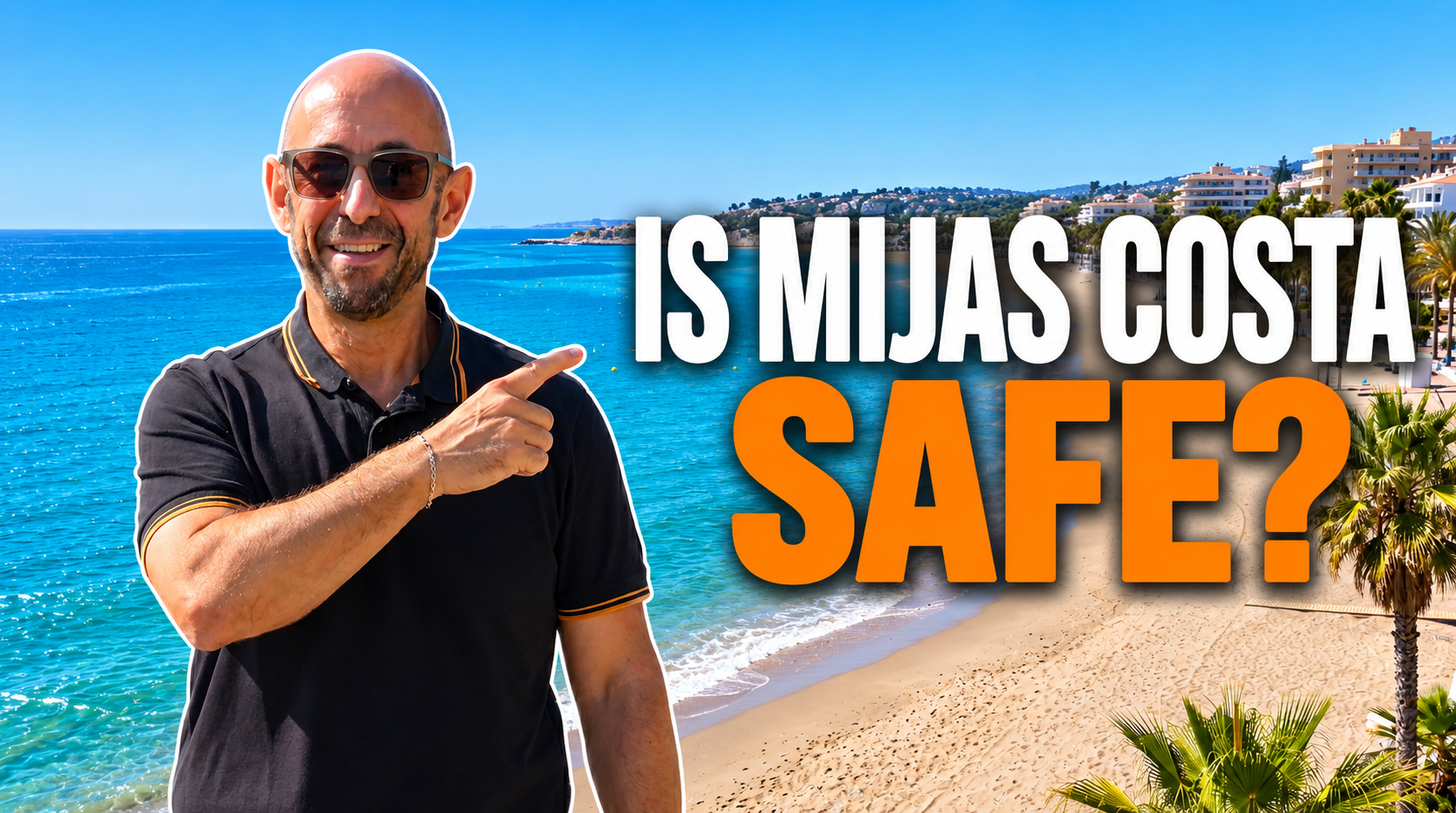
If you’re thinking about buying a property in Spain, relocating to the Costa del Sol or purchasing a holiday home, there’s one question that often comes up sooner or later: Is Mijas Costa safe?
It’s a perfectly reasonable question. Buying a property abroad is a major decision, and feeling comfortable in your surroundings is just as important as finding the right apartment, villa or location.
The good news is that Mijas Costa has a generally relaxed residential atmosphere, with a lifestyle that many international buyers find particularly appealing. Families walk along the coastal boardwalk in the evenings, restaurants remain busy late into the night and residents enjoy a relatively easy-going Mediterranean way of life.
But what do the official crime figures actually tell us? How does Mijas compare with neighbouring Marbella and Fuengirola? Are gated communities safer? And what should holiday homeowners do to protect their properties when they’re back home?
Having lived and worked on the Costa del Sol for more than 20 years, I’ve put together this guide to give you an honest, practical overview.
Is Mijas Costa a safe place to live?
In short, yes. Mijas Costa is generally considered a safe place to live, and the everyday experience of residents reflects the relaxed lifestyle that attracts so many people to this part of Spain.
Of course, no town or residential area is completely crime-free. Petty theft, online scams, opportunistic burglaries and other incidents can happen, just as they can in the UK, Ireland or elsewhere in Europe.
However, there’s an important distinction between the occasional crime reported in the news and the day-to-day experience of living somewhere.
For most people living in Mijas Costa, everyday life is relatively peaceful. Walking along the beach, meeting friends for dinner, visiting local shops or enjoying an evening stroll are all part of normal life here.
It’s one of the reasons why the area continues to attract families, retirees, remote workers and international property buyers.
What do the official crime statistics say about Mijas?
Rather than relying solely on anecdotal experiences, it’s worth looking at the official figures.
Spain’s Ministry of the Interior publishes crime statistics covering municipalities throughout the country. These provide a useful way of comparing reported crime levels between different towns and cities.
For this comparison, it’s important to understand exactly what is included in the figures.
Mijas is a large municipality, covering considerably more than just the coastal strip. It includes:
- Mijas Pueblo, the traditional white village in the hills.
- Las Lagunas, the larger residential and commercial area inland.
- La Cala de Mijas and the surrounding coastal communities.
- Calahonda, Riviera del Sol, Miraflores and El Chaparral.
- Residential areas extending towards La Cala Golf.
This means the official figures cover the wider municipality rather than Mijas Costa alone.
When comparing the latest figures reviewed for this guide, Mijas presents a reassuring picture. Its overall crime rate sits close to the national average and compares favourably with neighbouring coastal municipalities, including Marbella and Fuengirola.
The figures also indicate an improving trend.
As always, crime statistics need to be interpreted carefully. Different types of crime have different impacts on residents, and municipal averages don’t necessarily reflect the experience of every individual neighbourhood.
Nevertheless, the official figures provide useful reassurance for anyone considering making Mijas their home.
For the latest information, you can consult the Spanish Ministry of the Interior’s crime statistics.
What do people who live in Mijas Costa think about safety?
Statistics are useful, but they don’t always tell the whole story.
We spoke to several people who own properties in Mijas Costa and La Cala de Mijas, asking how safe they feel living here and how the area compares with their home countries.
The responses were overwhelmingly positive.
Some of the people we spoke to have owned properties here for more than 20 or even 30 years. Others have been residents for less than a decade.
A recurring theme was the relaxed atmosphere, friendly local community and the ability to walk around comfortably, including in the evenings.
One resident compared the feeling of safety favourably with central London, while others said they felt comfortable walking alone or with their families.
Naturally, people still take sensible precautions. Locking doors, looking after personal belongings and being aware of their surroundings are common-sense measures wherever you live.
But the general feeling among the people we interviewed was that Mijas Costa is a comfortable and welcoming place to call home.
In the video above, we look at the official figures, hear directly from local residents and explain the different types of gated communities found along the coast.
Are gated communities in Spain safer?
One of the attractions of buying an apartment or townhouse on the Costa del Sol is the availability of gated residential communities.
But the term ‘gated community’ can mean quite different things in Spain.
In Mijas Costa, I’d generally divide them into three categories.
1. Large residential urbanisations with private security patrols
Some of the larger urbanisations, particularly in Calahonda, have private security companies that patrol the streets.
These are extensive residential areas containing thousands of homes, so rather than having one entrance gate controlling access, security vehicles circulate around the development.
The cost is normally covered through community or urbanisation fees.
The advantage is having additional eyes on the streets and a quicker response if something is reported.
2. Enclosed gated communities
This is probably what most people imagine when they hear the words gated community.
These developments typically have a perimeter wall or fence, a controlled vehicle entrance and sometimes pedestrian access using a key, remote control or entry code.
They offer an additional layer of privacy and help discourage casual access by people who don’t live there.
However, a gated entrance doesn’t automatically make a property burglar-proof. Individual apartments, terraces, patios and ground-floor access points still need appropriate security.
3. Communities with 24-hour security
At the higher end, some residential developments employ security personnel around the clock.
This can provide additional reassurance, particularly in larger complexes or developments with extensive communal facilities.
However, it’s worth remembering that 24-hour staffing comes at a cost. In practical terms, covering three eight-hour shifts requires several members of staff, and this will generally be reflected in the community fees.
For some buyers, the additional peace of mind is well worth paying for. Others may prefer a development with lower running costs and a simpler security arrangement.
There isn’t necessarily one right answer. It depends on your priorities, budget and how you intend to use the property.
What should you check before buying in a gated community?
If you’re viewing properties in Mijas Costa, don’t simply assume that a development is secure because it has gates or security cameras.
I’d recommend asking the community administrator a few straightforward questions:
- Is there a private security company, and what exactly does it provide?
- Are there security guards on site, or are patrols carried out periodically?
- Are CCTV cameras installed, and is anyone actively monitoring them?
- How is access to the development controlled?
- How many properties are occupied throughout the year?
- Are there regular community security reports or known issues?
That last question is particularly important.
A development with a healthy number of permanent residents throughout the year is likely to have more people coming and going, keeping an eye on communal areas and noticing anything unusual.
A complex made up predominantly of holiday homes may be much quieter during the winter months.
Neither arrangement is necessarily better, but it’s something worth understanding before making a purchase.
If you’re researching different parts of the area, our Mijas Costa property and area guide explains the differences between the main residential communities.
When is the risk of property break-ins highest?
One thing that may surprise holiday homeowners is that summer isn’t necessarily the time to be most concerned about property security.
While the summer months bring more visitors and increased activity, quieter periods during the autumn and winter can present different challenges.
October and the winter months are particularly worth considering because many holiday homeowners return to their home countries, leaving properties unoccupied for extended periods.
An empty apartment or villa can become more vulnerable if there are no neighbours nearby, no regular visits and no obvious signs of activity.
This doesn’t mean you should be worried about leaving your Spanish home. It simply means that a little preparation before travelling home can make a significant difference.
Four simple ways to protect your Spanish holiday home
If you own a property in Mijas Costa but only visit for part of the year, there are four practical measures I’d recommend.
1. Install a properly maintained alarm system
A monitored alarm provides an additional layer of protection and can alert you or a security company if something happens.
Make sure the system is serviced regularly, with particular attention to sensors, batteries and communications.
2. Don’t overlook terrace doors and rear access
Many owners concentrate on their front door but forget about less visible access points.
Ground-floor terraces, patio doors and rear entrances deserve just as much attention.
Check that locks are secure and consider additional security measures where appropriate.
3. Consider installing security cameras
Modern CCTV systems can allow you to check your property remotely and receive alerts when movement is detected.
Look for a system that records and stores footage rather than simply providing a live view.
Make sure any installation complies with applicable privacy and data protection requirements.
4. Arrange for somebody to check your property
This is arguably one of the most useful things you can do.
A trusted neighbour, keyholder or professional property manager can visit periodically, check that everything is in order and spot potential problems before they become serious.
They can also identify issues such as water leaks, electrical problems or damage following bad weather.
Having somebody locally who can access your property when you’re abroad provides considerable peace of mind.
If you’re buying a holiday home in Spain, it’s worth thinking about property management arrangements before you complete your purchase.
Does Mijas Town Hall take steps to improve security?
Local authorities also have a role to play in maintaining public safety.
Mijas Town Hall has installed security cameras across parts of the municipality, with further cameras planned for key entrances and locations.
These systems can assist local police and help monitor activity around the municipality.
It’s another part of the wider approach to maintaining a safe environment for residents and visitors.
Is Mijas Costa safer than Marbella or Fuengirola?
This is a question that often comes up when buyers are comparing different parts of the Costa del Sol.
Based on the official municipal crime figures reviewed for our video, Mijas compares favourably with both Marbella and Fuengirola, with a lower overall reported crime rate in the comparison.
However, it’s important not to assume that every neighbourhood within one municipality is safer than every neighbourhood in another.
Marbella, Fuengirola and Mijas all contain a mixture of residential areas, commercial centres, busy tourist locations and quieter communities.
The best approach is to look beyond the headline figures and consider the specific location, development and type of property you’re buying.
For a broader understanding of the area, take a look at our guide to Mijas Costa and how it compares with the rest of the Costa del Sol.
So, is Mijas Costa a safe place to buy property and live?
Based on the official figures, the experiences of local residents and our own time living and working here, Mijas Costa is a place we’d be very comfortable recommending to people considering a move to the Costa del Sol.
The everyday lifestyle is relaxed, the residential communities are well established and there are plenty of options for buyers who want additional security.
Of course, sensible precautions are important, particularly if you’re purchasing a holiday home that will be empty for several months each year.
Choose your development carefully, understand what security arrangements are in place and make sure somebody can keep an eye on your property when you’re away.
Ultimately, buying a property in Spain should be about finding somewhere where you feel comfortable, secure and happy spending your time.
That’s something we believe is particularly important when choosing the right location.
Frequently Asked Questions About Safety in Mijas Costa
Is Mijas Costa safe for families?
Generally, yes. Mijas Costa is popular with families and offers a relaxed residential lifestyle, with beaches, parks, schools, restaurants and family-friendly communities. As anywhere, normal precautions are sensible.
Is it safe to walk around Mijas Costa at night?
Many residents feel comfortable walking around Mijas Costa in the evenings, particularly in established residential areas and along busy coastal promenades. As with any destination, it’s sensible to remain aware of your surroundings and use well-lit routes.
Is crime a problem in Mijas Spain?
Crime does occur in Mijas, as it does elsewhere in Spain. However, the official municipal figures reviewed for our guide are reassuring, and the overall picture is relatively calm. Opportunistic theft, scams and property-related incidents are among the issues worth being aware of.
Are gated communities in Mijas Costa worth paying extra for?
They can be, depending on the level of security provided and your personal priorities. Some developments offer private security patrols, controlled entrances or 24-hour guards. Always check exactly what is included and how much it adds to your community fees.
Are holiday homes in Spain at risk of burglary?
Any unoccupied property can be vulnerable, particularly if it is left empty for extended periods. A maintained alarm, secure doors and windows, cameras and regular visits from a trusted keyholder can all help reduce the risk.
Is Mijas safer than Marbella and Fuengirola?
The official municipal figures reviewed for this article show Mijas comparing favourably with Marbella and Fuengirola in terms of overall reported crime. However, individual neighbourhoods and types of crime vary, so comparisons should be treated as a general guide rather than a guarantee.
What is the safest area to buy property in Mijas Costa?
There isn’t one single area that can be described as the safest for everyone. Calahonda, La Cala de Mijas, Riviera del Sol, Miraflores and El Chaparral all have established residential communities, with different security arrangements. The individual development and property are often more important than the area name alone.
Thinking About Buying Property in Mijas Costa?
At Target Property Spain, we help international buyers find properties across Mijas Costa and the wider Costa del Sol.
Whether you’re looking for a holiday apartment in Calahonda, a family home in La Cala de Mijas or a villa in Riviera del Sol, we can help you understand the different areas, developments and lifestyle options.
We believe in honest advice, local knowledge and a no-pressure approach.
If you’d like to know more about a particular urbanisation, its security arrangements or what it’s like to live in the area throughout the year, just get in touch.
Target Property Spain – Costa del Sol property, without the pressure.